Pocket Tour Guide
Ubud District
Ubud District · Indonesia

Sacred Groves & Ubud Stories

6.5hDuration
7Stops
12.4 kmDistance
The city

Ubud District

Listen

Somewhere around the ninth century a Javanese priest named Rsi Markandeya came down from a mountain, planted a spear or some say just a sacred keris in the ground at the meeting point of two rivers, and declared it holy. The spear stayed put, the rivers kept flowing, and roughly twelve hundred years later you've got motorbikes squeezing past temple processions and a monkey forest that charges less for entry than you'll spend on a single iced coffee twenty meters from its gates. That's Ubud for you — it never quite decided whether it's a sacred site or a scene, so it just kept being both, loudly, at the same time.

The name itself comes from "ubad," meaning medicine, because this valley was once where people came for healing herbs — which tracks, because today it's still where people come to heal, just with more yoga mats and fewer actual plants involved. Geographically it's wonderfully simple once you get the shape of it: one main crossroads where Jalan Raya Ubud meets Monkey Forest Road, and from there everything ripples outward into rice terraces and ravines. Walk ten minutes in any direction and the island-of-the-gods sincerity comes roaring back — kids in ceremonial white, incense smoke curling off a thousand doorstep offerings called canang sari that someone rebuilds every single morning like clockwork, because the gods, apparently, do not accept day-old flowers.

This whole area sits under the Balinese Hindu calendar, which runs on its own 210-day cycle, so you'll stumble into a festival you had absolutely no way of predicting — maybe Galungan, when the ancestors visit and bamboo poles called penjor arch over every street like the village is throwing a parade for ghosts. Mind the temple etiquette — sarong on, shoulders covered, and never, ever step over an offering on the ground, even if it's sitting squarely in your path to breakfast. The royal family still lives at Puri Saren Agung right on the main square, which always delights people — a palace, hiding in plain sight, next to a bakery.

So lace up your shoes, because today's rhythm is: rice paddies at golden hour for the photographs everyone secretly came for, the Campuhan Ridge walk if you want green hills rolling out like a slow exhale, and little warungs tucked down alleys where the nasi campur is better than anywhere with a view and a markup. Ubud rewards the wrong turn — I've gotten pleasantly, gloriously lost here more times than I can count, and not once did it go badly. Let's go get lost properly.

The route

7 stops through Ubud District

1
Museum Puri Lukisan
museum

Museum Puri Lukisan

Ubud’s principal art museum traces the island’s artistic evolution through Balinese painting, woodcarving, and tranquil garden galleries.

65 min · rated 4.4
Open in Google Maps

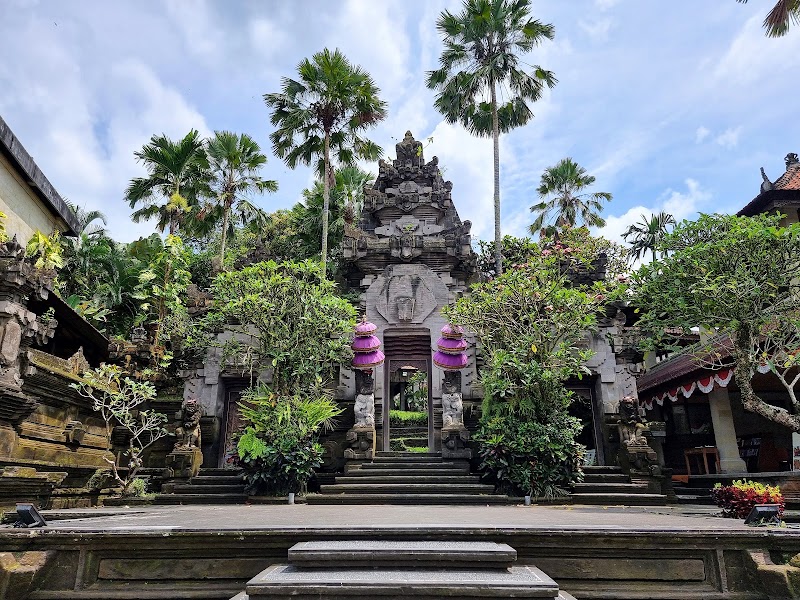
Look at that gate before you even think about going inside — carved stone, thick with little figures, the kind of door that tells you someone took their time. That's the first lesson Bali teaches you about art: nobody here is in a hurry to finish anything beautiful. My brothers and I used to race up hills for a view — here, you walk slow on purpose, because the garden between the galleries is doing half the storytelling.

This place is Ubud's own hall of memory, really — room after room tracing how Balinese painting actually moved through time, from the old temple-style work into something newer, looser, more personal. You'll see woodcarving too, wood that somebody's grandfather probably could have told you stories about, shaped into figures so fine you forget it was ever just a block of jackfruit timber. Walking through feels less like a museum and more like watching a conversation between generations who never met but somehow agreed on the same instinct — of fitting a whole world onto a small surface.

Here's a detail I like: the complex isn't one big box but a cluster of pavilions around ponds and courtyards, so the art breathes between buildings instead of hanging in one long fluorescent corridor. That's rare, and it's worth noticing — stop between galleries, let your eyes adjust from canvas back to greenery, and you'll see why the space itself is part of the collection, not just the container for it.

Take your time in the garden courtyard before you leave — that's the quiet, overlooked bit people rush past to get to the next gallery, and it's honestly my favorite corner here. When you're ready, grab a taxi or a bus toward Neka Art Museum, about twelve minutes from here — it picks up right where this story leaves off, with an even deeper dive into Balinese and Indonesian painting.
2
Neka Art Museum
museum

Neka Art Museum

Explore Balinese art and culture spanning from classical to contemporary.

55 min · rated 4.6
Open in Google Maps

Here's the thing nobody tells you about Balinese painting — it didn't stay still for anybody, and this place proves it room by room. You walk in expecting one kind of island art, the postcard version, and instead you get decades of it arguing with itself across several pavilions, like a family reunion where every generation painted the same mountain differently.

That's really the trick of this museum — it's organized so you can watch style evolve under your own feet. Classical Kamasan work in one wing, all flat gold and shadow-puppet poses telling stories from the epics, then you wander into rooms where Balinese artists started bending toward European technique, perspective, shading, and you can practically see the exact moment two art worlds shook hands. Keep an eye out for the photography collection too, if it's on display — black-and-white images of Bali from decades past, which hit differently after you've just seen the same landscapes painted.

Sculpture holds its own out in the garden spaces between buildings, so don't just sprint pavilion to pavilion — let your legs slow down where the stone and bronze pieces sit among the trees. That in-between space is where I always catch my breath, honestly, because after three rooms of paintings your eyes start needing something three-dimensional to chew on.

Give yourself a real hour here if you can — it's bigger and slower than it looks from the gate. When you're done, don't walk it — grab a taxi or a quick ride, about twelve minutes, over to Pura Taman Kemuda Saraswati, the water palace. Trade painted lotus ponds for the real thing.

3
Pura Taman Kemuda Saraswati (Water Palace)
temple

Pura Taman Kemuda Saraswati (Water Palace)

A pathway over a scenic lotus pond leads to this Hindu temple with ornate architectural details.

25 min · rated 4.2
Open in Google Maps

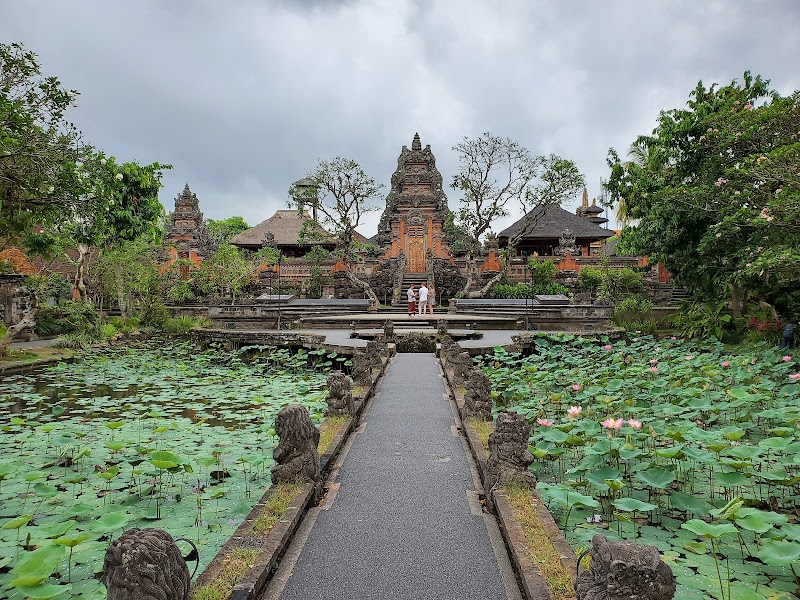
Look down before you look up — that's the trick here. Everyone's eyes go straight to the carved gateway, the stone guardians, the roofline stacked up like a wedding cake for giants. But the real show is at your feet, that long stone walkway cutting straight across a pond absolutely stuffed with lotus plants. In Naples we'd kill for a traffic circle this calm.

This is Pura Taman Kemuda Saraswati — a temple dedicated to Saraswati, who in Balinese Hindu tradition is the goddess of knowledge, music and the arts, which honestly makes her the patron saint of anyone who's ever tried to learn guitar and failed. Fitting, too, since you're standing in Ubud, a town that's spent decades calling itself Bali's cultural heart. The pond and the pathway aren't decoration — they're doing a job, visually separating the sacred space from the ordinary street dust you just walked through, water as a kind of soft border guard.

Look for the carvings as you get closer to the inner gate — the kind of dense, almost obsessive stonework where every surface seems to be having its own conversation, flowers and guardian figures and scrollwork stacked on scrollwork. Local worship still happens here, so you may see offerings tucked along the edges, small woven palm-leaf trays with flowers and rice — don't step on them, they're not litter, they're somebody's actual prayer having a rough day in the heat.

For your photo, get down low near the pond's edge so the lotus pads fill your foreground and the temple's split gateway — the candi bentar — rises up behind them; that's the shot that makes everyone back home ask "wait, is that real?" Then when you've had your fill of goddess-of-knowledge energy, it's a short four-minute stroll to Ubud Palace, which is next on our little parade.

4
Ubud Art Market
market

Ubud Art Market

35 min · rated 4.0
Open in Google Maps

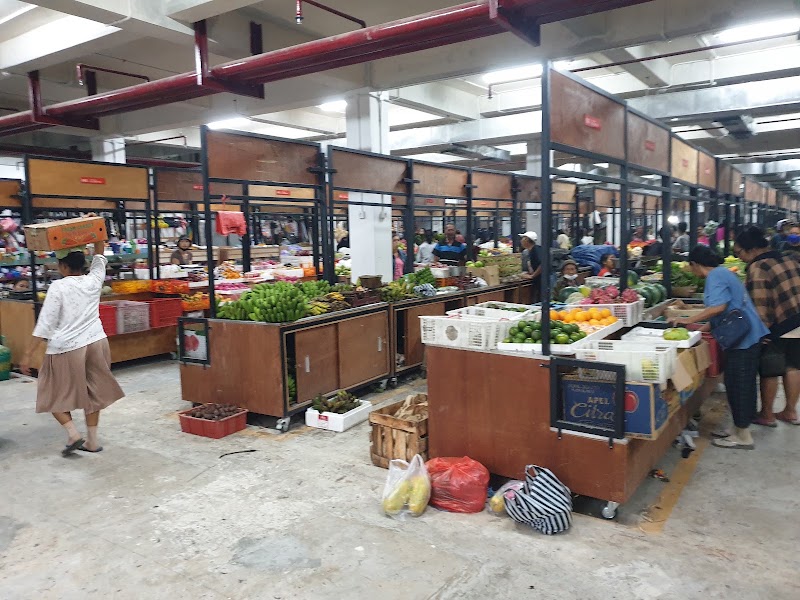
Listen — you hear that? That hum, like a beehive that learned to bargain? That's the sound of the Ubud Art Market, and I'm telling you, after the quiet of that water garden we just left, this place hits you like a splash of cold Bintang on a hot day. Good shock. The kind that wakes you up.

Now, I always tell people: this is not a museum, so forget your soft voice and your respectful nodding. This is a marketplace in the full, ancient, chaotic sense — baskets stacked on baskets, sarongs in every color a volcano island can dream up, wind chimes clanging a tune only the wind understands. Ten in the morning to five in the afternoon, Monday through Monday practically, the stalls open like flowers and the whole street becomes elbow-to-elbow theater. Locals come here too, not just us wandering tourists — Balinese families buying offerings, baskets, incense, the daily stuff of ritual life, right alongside the sun hats and the wooden masks angled at us wide-eyed travelers.

Here's my advice, and I give it like a brother, not a guidebook: half the price they tell you first is a starting position, not a fact. Smile, laugh a little, offer less than you think is fair, and watch the vendor's eyes — if they laugh back, you're playing the game right. Nobody's offended. It's practically a local sport, like football, except everyone wins a little.

For the photo — stand back at the entrance and frame the market gate itself, that carved stone threshold with the open chaos of color spilling out behind it, roofs of umbrellas and sarongs doing all the work for you. Then, when you've got your haggling scars and a bag full of things you didn't know you needed, it's just two minutes on foot to Ubud Palace — go on, I'll meet you by the gates, we've got kings and dancers waiting.

5
Ubud Palace
landmark

Ubud Palace

Iconic temple featuring art, Balinese dance performances in its courtyard & lush surrounds.

30 min · rated 4.3
Open in Google Maps

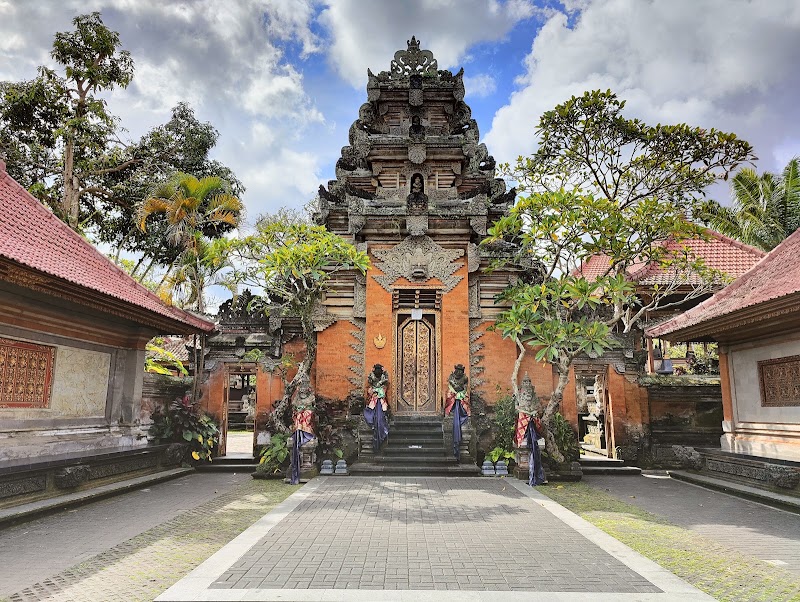
Look at those gates for a second before you walk through — all that carved stone, dark and swirling like someone poured ink into sandstone and let it grow roots. That's the candi bentar, the split gateway, and every palace and temple compound worth its salt in Bali has one. You just came from the chaos of the art market, bargaining for sarongs, and now — bam — you're standing in front of royalty's front door. Balinese architecture doesn't believe in subtlety as a transition.

This was a royal house, and in some ways it still is — the local royal family's descendants are tied to this place, which is rarer than you'd think on an island where palaces usually end up as postcards or parking lots. Wander into the courtyards and you'll see why photographers never put their cameras down here: frangipani trees heavy with flowers, stone guardians draped in that black-and-white checkered cloth — poleng, it's called, it means the guardian's keeping balance between good and bad, light and dark, all the cosmic paperwork sorted out in one bit of fabric.

Come back after the sun's low — not now, just tuck this away for later — because this courtyard turns into a stage. Balinese dance, gamelan orchestra, the whole works, performed right where kings used to hold court. That's not a show put on for tourists in some separate building; that's the actual palace grounds doing what palace grounds have always done, just with a ticket booth now instead of a sword at the gate.

Give yourself a good wander — the compound's small enough that you won't get lost, which, after some of my famous "shortcuts," might be a relief. Frame a shot through the split gate with a stone guardian in the foreground and the inner pavilion behind — that's the one that'll make your friends jealous. Then when you're ready, grab a taxi or a quick bemo — about twelve minutes — over to ARMA Museum, where the dancing you just imagined gets painted, literally, all over the walls.

6
museum

ARMA Museum

A cultural oasis featuring art and traditional performances.

60 min
Open in Google Maps

You know what I love about this place? It doesn't shout. No giant gate screaming "ART INSIDE," no ticket tout chasing you down like in some other museums I won't name. Just gardens, low rooftops, and the kind of quiet that makes you lower your voice without anyone telling you to — like walking into a library that happens to have five hundred years of Balinese painting hanging on the walls instead of books.

I bring people here after the Palace because the energy shift does something to you. Over there you had kings and stone guardians and crowds angling for photos. Here, it's just canvas and color and the occasional gecko judging your art commentary from the ceiling. Painting in Bali was never really a wall-hanging hobby the way we think of it in Europe — it was tied to temple ceremony, to story-telling, calendars, mythology. This museum, in its quiet way, is one of the places holding onto that thread so it doesn't snap.

Stand close to the older pieces if you can — the fine, almost obsessive linework, the crowded compositions where every inch is busy with gods, demons, dancers, village life, all happening at once, no empty space allowed, like the painter was terrified of silence on the canvas. That's a very specific Balinese style, and it's worth noticing with your nose practically on the glass — the guidebooks mention "traditional art" and move on, but the detail is where the whole philosophy lives.

Take your time in the garden courtyard too — if there's a performance scheduled during your visit, that's the place to post up, because traditional dance here isn't staged for spectacle, it's the same gestures and stories the paintings tell, just set in motion. When you're ready, we'll grab a taxi — it's about twenty-two minutes to Yeh Pulu, where the real stone-carved storytelling begins, carved straight into a cliff instead of hung in a frame.

Listen
7
Relief Yeh Pulu
landmark

Relief Yeh Pulu

A remarkably intimate rock-cut frieze follows a shaded path, depicting everyday Balinese life in scenes that feel far removed from Ubud’s busy centre.

60 min · rated 4.0
Open in Google Maps

Here's the thing nobody tells you about Yeh Pulu — you have to earn it. No grand gate, no ticket booth with a man in uniform waving you through. Just a little path that drops down through the rice fields, past a stream, and suddenly the rock wall just... starts talking.

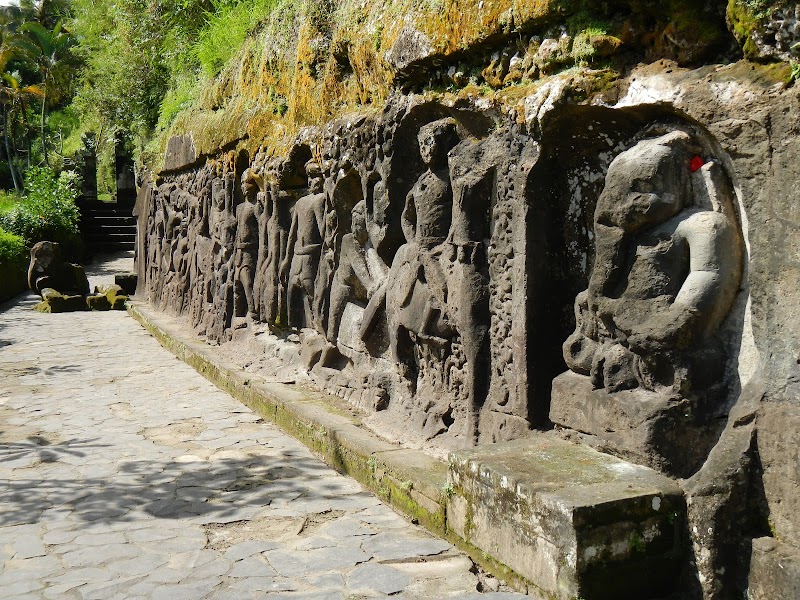
Look at the length of this thing. It is carved straight into the living rock face, a whole procession of scenes running along the stone — men carrying game on poles, a woman grabbing the tail of a horse, wild boar hunts, everyday figures caught mid-motion like someone hit pause on fourteenth-century Bali. No gods lounging on lotus thrones here, no epic battles from the Ramayana. This is market day, hunting day, ordinary day — carved by someone who apparently found regular people more interesting than kings. I happen to agree with them.

What gets me every time is the scale of the place — intimate, almost shy. After the grandeur you have just walked through, this feels like someone pulled you aside to show you a home movie instead of the highlight reel. The shade from the trees, the sound of the stream, the rice terraces climbing up behind you — it does not perform for you the way the big temples do. It just sits there, quietly excellent, waiting for the handful of people who bother to find it.

So here is my advice for closing out the day right: stand back a few steps and take in the whole relief in one frame, with the greenery as your backdrop — that is your shot. Then get close, really close, to one single figure and just look at the chisel marks. Somebody's hand did that, centuries ago, with nothing but patience and a good eye. Breathe it in, let your legs rest a moment by the stream, and call it a day — you have earned this ending far more than the crowds back in central Ubud ever will.

Route map
Powered by Geoapify · © OpenMapTiles · © OpenStreetMap contributors
Behind the day

How it was made

Built around

Interests
HistoryArt & museumsNatureHidden gemsLocal life

Shape of the day

Length
6 hours planned
Time of day
Morning start
Pace
Balanced

Asked for

Access
Transport is fine (taxi, bus, bike)
Narrated in
English
Planned and narrated by Pocket Tour Guide from these answers.
Keep wandering

Other days, made public

Reykjavik
Reykjavik · Iceland

Sagas, Sculpture & Skyline Views

8 stops · by Mario
Tromsø
Tromsø · Norway

Arctic Stories & Wooden Tromsø

6 stops · by Mario
Chișinău
Chișinău · Moldova

Chișinău’s Civic Heart & Quiet Curiosities

7 stops · by Mario
Lefkada
Lefkada · Greece

Lagoon Light & Wooden-Laned Lefkada

7 stops · by Mario

Put a storyteller in your pocket.

Your next free afternoon deserves better than a top-10 list.

Made with ♥ and Pineapples by zuapp.me